

Resources
The table below provides an overview of the supported resource types, their schema, and any notes on their sync behavior: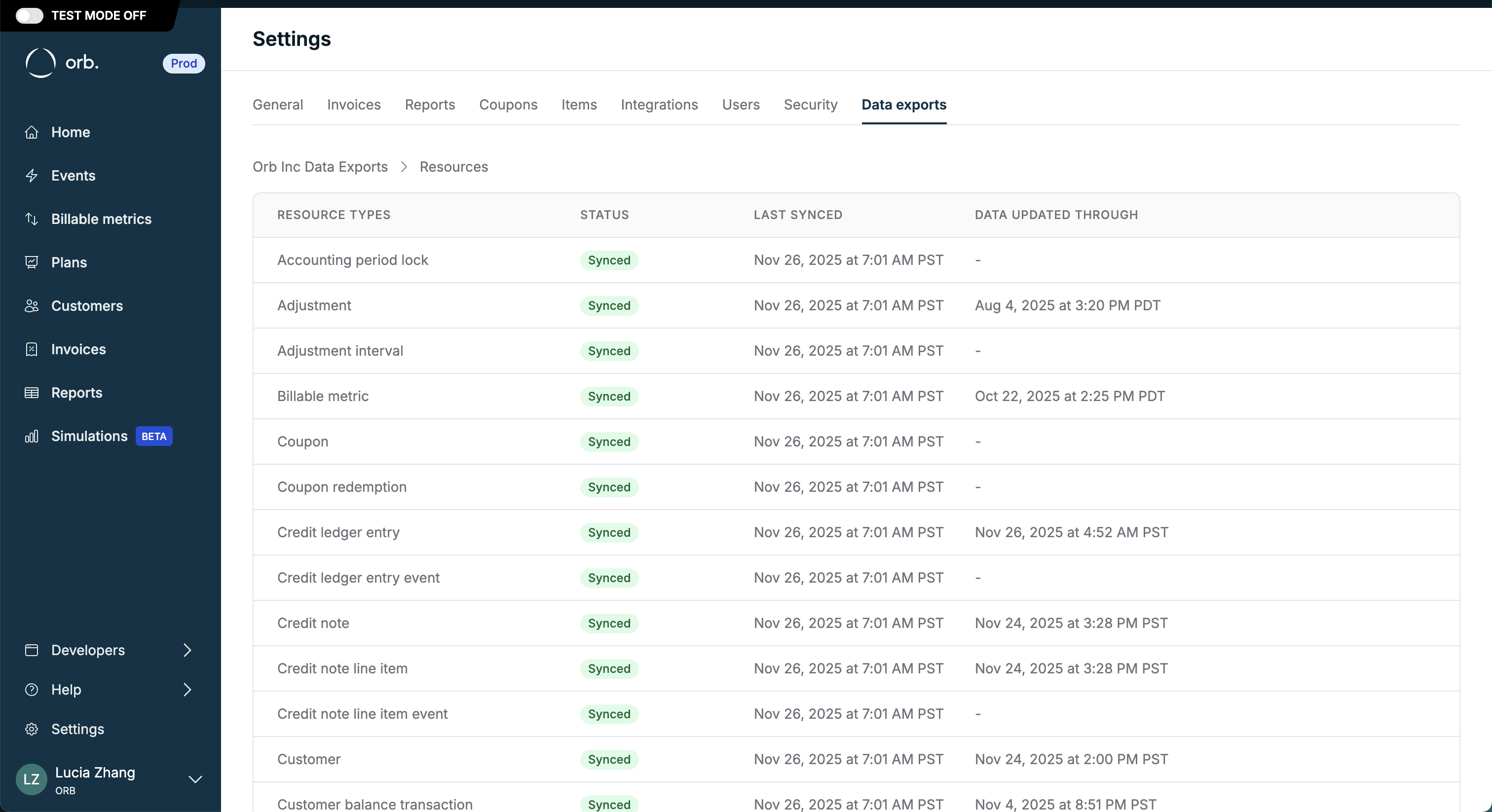
General guidance
API-based resources
A subset of Orb’s exported resources are based off of the API response shape. These are not directly defined below, but linked to the relevant API reference documentation, and may change as the API evolves. In addition, these resources often include JSON fields that require further parsing and are less well defined.List of resources
The following resource schemas are dependent on the API resources:Customer, Plan, and Subscription resources will always have deletion markers in addition to the API response shape.
Nested resources
API-based resources often contain nested fields that reference other objects. For example, the Plan resource references Prices which are a separate, top-level resource. Additionally, API‑based resources often include nested or “helper” fields that duplicate parts of other objects for convenience. These embedded fields are intended to make simple questions easier to answer in a single query and to keep exports readable without many joins. Dedicated resource recommendations to optimize for freshness of common helper fields:Resource schemas
Accounting Period Lock
Overview
The accounting period lock resource represents the history of the lock postures of monthly accounting periods in Orb. By default, accounting period entries are initialized in Orb as open, and can be closed by a user. Orb only generates entries for accounting periods when closing open periods or opening closed periods.- If no entries exist for any accounting periods, this means that all periods are currently open.
- If only one closed accounting period exists, this means that all periods before that closed period are also closed, and all periods after it are open.
sequence_number incremented. Importantly, a single entry for an accounting period only describes the lock posture of that period at a certain time.
To determine the timeline of actions performed on an accounting period, reference all entries for that period in order of ascending sequence_number.
To determine the current state of an accounting period, reference the entry for that period with the largest sequence_number.
Schema
Adjustment
Overview
The adjustment resource represents a minimum, maximum, or discount that can be applied to a single price or a set of prices. See the Adjustments section for more information. The adjustment table is most useful when joining with other tables using theadjustment_id field. For example,
- you can see how a coupon is defined by the
adjustment_idlinked on the coupon resource - you can better understand how an adjustment is applied onto a daily line item revenue resource by inspecting the
adjustment_idscolumn in the Daily Line Item Revenue resource
Schema
Adjustment Interval
Overview
The adjustment interval resource represents a time frame during which an adjustment applies to a subscription. See editing subscriptions and add or edit price intervals for more information.Schema
Billable Metric
Overview
A billable metric defines an aggregation over usage events.Schema
Commitment
Overview
A commitment represents a customer’s spend commitment on a subscription, drawn down over the commitment’s term. See commitment management for more information. Drawdown activity against a commitment is captured by the Commitment Ledger Entry Event resource.Schema
Commitment Ledger Entry Event
Overview
The Commitment Ledger Entry Event resource represents the operations that draw down a Commitment (for example, increments and decrements), captured as separate created and reverted events. This resource is helpful for understanding how a commitment gets burned down over time. Like the other*Event resources, entries are emitted as distinct creation and revert events (distinguished by the is_revert field). Unlike the Credit Ledger Entry Event resource, this resource does not expose a lock_adjusted_timestamp.
Schema
Coupon
Overview
A coupon represents a reusable discount configuration that can be applied either as a fixed or percentage amount to an invoice or subscription.Schema
Coupon Redemption
Overview
The Coupon Redemption resource type represents a coupon that has been redeemed by a customer.Schema
Credit Ledger Entry
Overview
The Credit ledger entry resource represents the various operations that occur for each credit block (e.g. increments and decrements). This resource is helpful to understand how a credit block gets burned down.Schema
Credit Ledger Entry Event
Overview
This resource represents the same data as Credit Ledger Entry, but also includestimestamp, lock_adjusted_timestamp, and is_revert fields, enabling the recognition of credit block operations with respect to the accounting period lock posture at the time of the operations.
Schema
Credit note
Overview
The Credit note resource type represents a credit note that has been issued to a customer. A credit note is a document that can be used to decrease the amount due or issue a credit for an already issued invoice.Schema
Credit Note Line Item
Overview
The Credit Note Line Item resource type represents a line item that is associated with a credit note.Schema
Credit Note Line Item Event
Overview
This resource represents the same data as Credit Note Line Item, but also includestimestamp, lock_adjusted_timestamp, and is_revert fields, enabling the recognition of credit note line items with respect to the accounting period lock posture at the time of credit note issuance.
Schema
Customer Balance Transaction
Overview
The customer balance is an amount in the customer’s currency, which Orb automatically applies to subsequent invoices. This balance can be adjusted manually via Orb’s webapp on the customer details page.Schema
Daily Credit Note Line Item Event
Overview
This resource represents the same data as Credit Note Line Item, but also includestimestamp, lock_adjusted_timestamp, and is_revert fields, enabling the recognition of credit note line items with respect to the accounting period lock posture at the time of credit note issuance. Entries are scoped to day boundaries.
Schema
Daily Line Item Revenue
Overview
The Daily Line Item Revenue resource type can be used to track the daily quantity and associated costs for invoice line items. This resource type will function similarly to the subscription costs endpoint, but with more fine grained access to information. This information can be used to power use cases like:- Daily revenue recognition workflows
- Running pricing exercises
reverted_at field but will still exist in the table. This means that historical queries can be constructed to understand what values were returned in the past.
The Daily Line Item Revenue resource type relies on upstream processes running to calculate these values. Importantly, this processing relies on the grace period ending before it can run. This means that entries in this resource type will be delayed. On average, we expect this delay to be approximately three days.
Schema
Daily Line Item Revenue Event
Overview
This resource represents the same data as Daily Line Item Revenue, but also includestimestamp, lock_adjusted_timestamp, and is_revert fields, enabling revenue recognition with respect to the accounting period lock posture at the time of original recognition.
Schema
Dimensional Price Group
Overview
The dimensional price group resource represents a dimensional price group that can be reused across prices and plans. See Create dimensional price group for more information. The dimensional price group table is most useful when joining with the Price table using thedimensional_price_group_id field. For example, you can use dimensional_price_group_id in the Price schema above to understand which prices partition the same billable metric (and by which dimensions), and use the dimension_values in the Price schema to understand which partition a particular price represents.
Schema
Invoice Line Item Billing
Overview
The Invoice Line Item Billing resource type can be used to track the individual line item values for invoices that have been issued / billed. This information can be used to power use cases like:- Calculating the precise amounts discounted per line item
- Breaking down the amounts billed for a specific price or billable metric
voided_at column.
The Invoice Line Item Revenue resource type relies on an invoice being issued before rows are written. Importantly, invoice issuing relies on the grace period ending before it can occur. This means that entries in this resource type will be delayed.
Schema
Invoice Line Item Billing Event
Overview
This resource represents the same data as Invoice Line Item Billing, but also includestimestamp, lock_adjusted_timestamp, and is_revert fields, enabling revenue recognition with respect to the accounting period lock posture at the time of original issuance.
Schema
Invoice Metadata
Overview
The Invoice Metadata resource represents a subset of data from the invoice resource. This resource also exposes draft invoices within Orb, which can be deleted at any time.Schema
Payment Application
Overview
The Payment Application resource represents the application of a successful payment to an invoice. This resource tracks how payments are allocated to invoices, linking each application to the payment attempt that generated it.Schema
Payment Attempt
Overview
The Payment Attempt resource represents each attempt to collect payment. This resource tracks the lifecycle of payment collection efforts, including automatic retries through Orb’s dunning process. Each payment attempt captures information about when the attempt was made, the payment provider used, the result of the attempt, and any associated error information.Schema
Item
Overview
The Item resource type represents a sellable product or good. Items are associated with all line items, billable metrics, and prices and are used for defining external sync behavior for invoices and tax calculation purposes.Schema
License
Overview
The License resource represents an entitlement provisioned on a subscription. Use this resource with License Type to reconstruct which entitlements were active on a subscription and when.Schema
License Type
Overview
The License Type resource represents a named license configuration and the grouping key Orb uses to attribute usage to individual licenses.Schema
Price
Overview
The price resource represents a price that can be associated with a plan, subscription, or invoice. See the Price configuration for more information. The price table is most useful when joining with other tables using theprice_id field. For example,
- you can see
price_idused in the Daily Line Item Revenue schema above to understand which price configuration generated specific revenue entries. - you can see
price_idused in the Invoice Line Item Billing schema above to understand which price configuration generated specific invoice line item values.
Schema
Price Interval
Overview
The price interval resource represents a time frame during which a price applies to a subscription. See editing subscriptions and add or edit price intervals for more information.Schema
Subscription version
Overview
The subscription version resource represents the subscription schedule for a given subscription, allowing for an understanding of underlying plan transitions. A given subscription may have multiple subscription versions mapped to it to track plan version changes and more.Schema
Legacy resources (deprecated)
Orb periodically deprecates older data export resources that no longer meet the product and infrastructure standards we require to support accurate reporting, scalable workloads, or new functionality. What you can expect from end of service:- This resource will no longer appear in the in-app UI, including the configuration table in settings.
- It will no longer be configurable for new connections—customers cannot create or enable new exports using the deprecated resource.
- Existing connections will stop syncing, meaning no new or updated data will flow to destinations after the deprecation date. Previously synced data will remain in your data warehouse.