

Once you’re sustaining more than roughly 10,000 events per second, we recommend moving to a cloud storage bucket sync (S3 or GCS) as your integration path, rather than sending events directly to the API. Batching events into files that sync to a bucket meaningfully improves the resiliency of your integration at high volumes, and it’s the approach we suggest once you’re consistently operating at this scale. This is guidance rather than a hard requirement, and is a separate ingestion option from hosted rollups described below—it does not require purchasing or enabling hosted rollups.
Orb’s hosted rollups architecture has undergone sustained stress testing well beyond 500,000 events per second, and Orb’s largest customers use hosted rollups to sustain several million events per second in production. If you have a specific event load you’re looking to support, our team can help you set up a test environment to illustrate how Orb can support your volume.
Architecture and configuration
Orb’s hosted rollups typically uses an intermediate cloud bucket as a durable message queue for events. A rollup configuration in Orb is defined by:- A set of grouping properties. This is a tuple of properties that identify each grouping that Orb emits per timeframe.
- An aggregation function for each property you’d like to aggregate in a given rollup. By default, Orb will also include the count of events in the rollup.
- The time window over which you’d like to compute the final rollups (default is 10 minutes).
- The frequency at which you’d like Orb to emit partial rollups (default is 30 seconds).
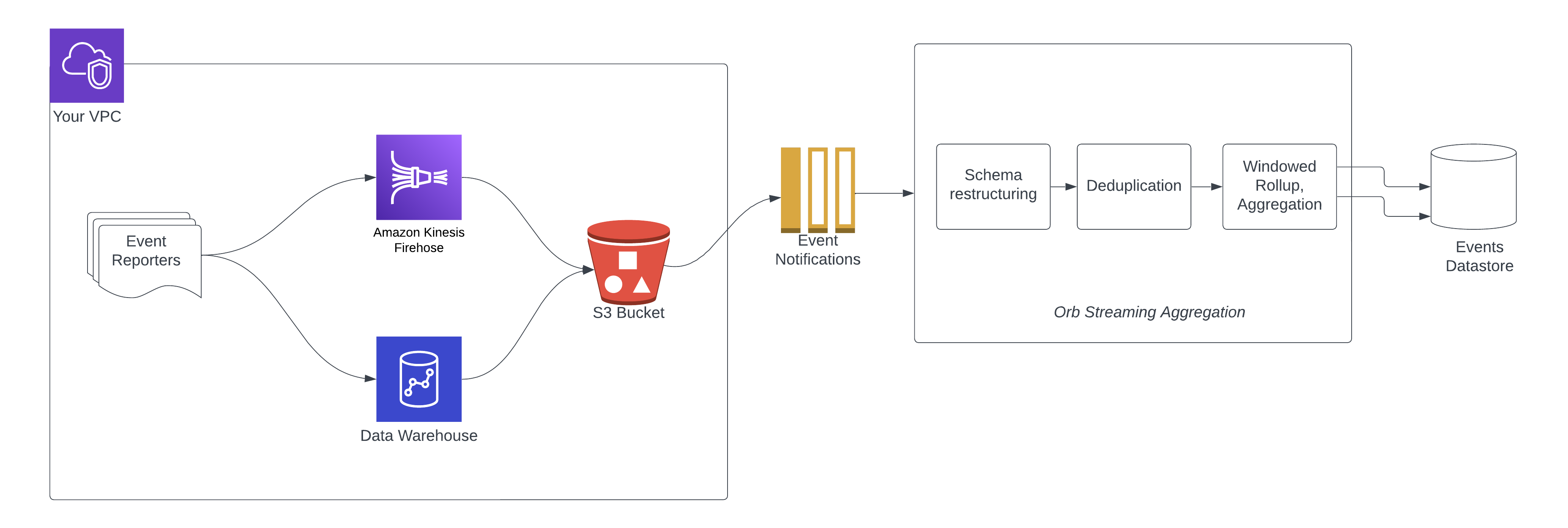
Example: Rollups on data download
Imagine you’re a file storage company that charges by the number of files downloaded and the total bytes downloaded. You offer three tiers of download speeds (fast, medium, and slow), charging more for higher speeds. Your customers download hundreds of thousands of files every second, and you send every download to Orb as a usage event with the following shape:idis the field Orb will use to deduplicate events.- The
customerproperty maps toexternal_customer_id, and uniquely identifies an Orb customer. download_timestampis the timestamp used to bucket events into rollup windows- Sum over
bytes_downloadedgrouping bydownload_speed - Aggregate over 10 minute windows, emitting partial rollups every 30 seconds
timestamp as the start of the aggregation window:
bytes_downloaded in the original payload translates to sum_bytes_downloaded in the ingested event, signifying that Orb has automatically summed this field for all events that have download_speed: fast, in the 10 minute timeframe 2022-08-14T15:10:00.000Z to 2022-08-14T15:``20``:00.000Z.
Once these events are ingested, you can then define billable metrics over them, retaining the flexibility to evolve the way you charge without running a backfill.
Querying over rollup events
Since Orb’s rollups feature also outputs intermediate rollups, it’s important that these are accounted for in the billable metric queries that you form over them, effectively by executing aGROUP BY over the relevant properties and the grouping.
Orb provides ergonomic syntax for querying over aggregated events as a “view”, abstracting this rollup mechanism away.
For example, the following query: